 +86-151 6276 6160
 vente002@hxdrobots.com
 English
 Español
 Pусский
 العربية

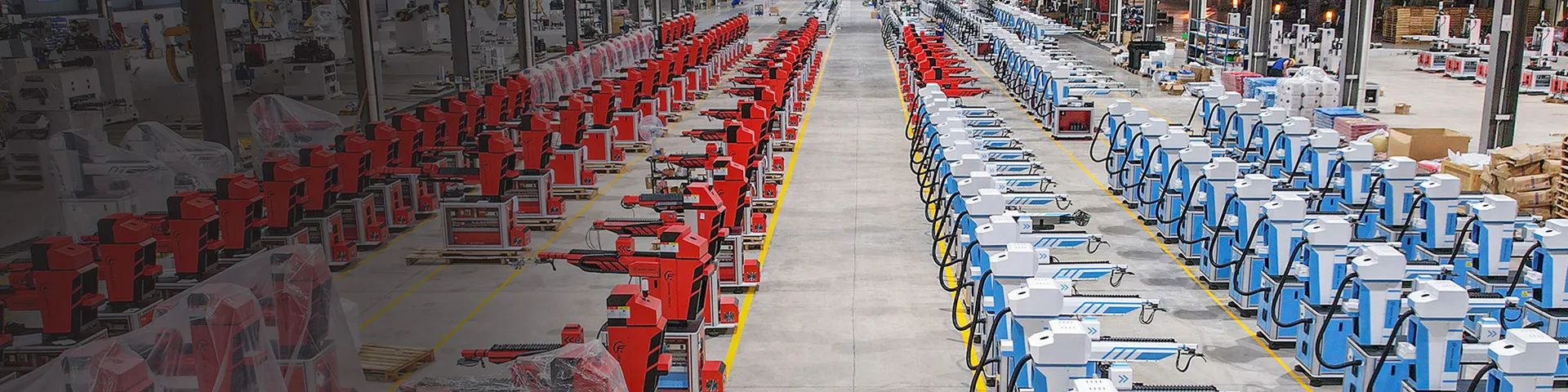
Certainly — here is a **1000-word English article** about **“Press Workshop Full Automatic Stamping robot.”**
---
Press Workshop Full Automatic Stamping robot
With the rapid development of industrial automation, the press workshop has become one of the most important production areas in modern manufacturing. In many industries such as automotive, home appliances, hardware, and electrical equipment, stamping processes play a key role in forming metal parts efficiently and accurately. To improve productivity, reduce labor costs, and enhance safety, the **full Automatic stamping robot** has emerged as an essential piece of equipment in the press workshop.
A full Automatic stamping robot is a robotic system designed to handle the entire stamping process with little or no human intervention. It is commonly used to load raw metal sheets or blanks into the press machine, transfer finished parts to the next station, and carry out precise handling operations at high speed. Compared with manual labor or semi-automatic systems, this robotic solution offers better consistency, higher efficiency, and superior safety performance.
The Role of Automation in the Press Workshop
Traditional stamping workshops often depend on manual feeding, unloading, and part transfer. Although this method may be suitable for small-scale production, it has many limitations. Workers may face fatigue, repetitive stress injuries, and potential danger from high-speed press machinery. In addition, manual operation can lead to inconsistent product quality and lower production efficiency.
The introduction of a full automatic Stamping robot has transformed the press workshop. By automating repetitive and dangerous tasks, the robot allows manufacturers to maintain stable production while minimizing human involvement. The system can work continuously for long hours, maintain accurate positioning, and improve the overall rhythm of the production line. As a result, companies can achieve greater output with fewer errors and lower labor dependency.
Main Functions of a Full Automatic stamping robot
The full Automatic stamping robot performs several important functions in the press workshop. First, it can automatically pick up raw materials from a feeder, conveyor, or stacking platform. Then, it places the sheet or blank precisely into the press mold. After the stamping operation is completed, the robot removes the finished part and transfers it to a designated area, such as a conveyor belt, collection tray, or inspection station.
Some advanced robots are also equipped with vision systems, sensors, and intelligent control software. These features allow the robot to detect part position, correct alignment errors, and ensure accurate handling even when the material shape changes slightly. In multi-station production lines, the robot can coordinate with several presses and transfer parts between them efficiently. This makes it possible to create a fully automated stamping production system.
Structure and Working Principle
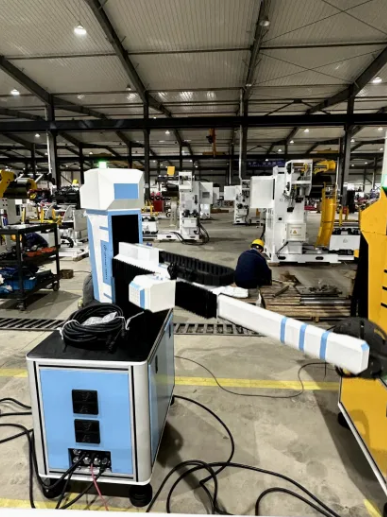
A full Automatic stamping robot usually consists of a robot arm, end effector, control system, sensors, safety devices, and communication interfaces. The robot arm provides movement in multiple directions, while the end effector is the tool used to grip or hold the workpiece. Depending on the application, the end effector may use vacuum suction, mechanical clamps, magnetic force, or a combination of methods.
The control system is the “brain” of the robot. It receives production commands, coordinates movements, and synchronizes the robot with the press machine. Sensors play an important role in ensuring precision and safety. They can detect the position of the material, monitor the status of the press, and prevent accidents caused by misalignment or unexpected movement.
The working principle is relatively simple but highly efficient. When the press machine completes one cycle, the robot receives a signal and immediately begins its action. It moves to the feeding position, grasps the workpiece, places it into the mold, waits for stamping, and then retrieves the finished part. This cycle repeats rapidly and accurately, allowing the workshop to maintain stable output.
Advantages of Using a Full Automatic stamping robot
One of the biggest advantages of the full automatic Stamping robot is improved productivity. Because the robot can operate continuously with high speed and precision, the production line becomes more efficient than manual operation. This is especially important in large-scale manufacturing where output volume is critical.
Another major advantage is quality consistency. Human workers may vary in speed and accuracy, but robots follow programmed instructions exactly. This reduces the risk of part damage, feeding errors, and defective products. As a result, manufacturers can maintain a more stable product quality.
Safety is also greatly improved. Stamping machines involve strong pressure, rapid movement, and heavy materials, which can be dangerous for workers. By replacing manual feeding and unloading with robotic systems, the risk of injury is significantly reduced. Workers can focus on supervision, maintenance, and quality inspection instead of dangerous physical tasks.
In addition, a full Automatic stamping robot helps reduce labor costs over time. Although the initial investment may be relatively high, the long-term benefits are significant. Lower labor requirements, reduced error rates, and higher production efficiency contribute to a strong return on investment.
Applications in Industry
Full automatic Stamping robots are widely used in various industries. In the automotive industry, they are used to stamp body panels, brackets, reinforcements, and structural parts. In the home appliance industry, they help produce metal shells, panels, and internal components. In hardware and electronics manufacturing, they are used for small precision parts that require accurate positioning and repeatable handling.
These robots are also suitable for production environments where part shapes are complex or where high precision is required. With the help of programmable settings, one robot can be adapted to different products and production cycles. This flexibility makes it a valuable tool for modern factories.
Future Development Trends
As smart manufacturing continues to grow, full Automatic stamping robots are becoming more intelligent and flexible. Future systems will likely include more advanced artificial intelligence, machine vision, and data analysis capabilities. These features will allow robots to make better decisions, adapt to changing production conditions, and optimize workflow automatically.
In addition, the integration of industrial Internet of Things (IIoT) technology will enable real-time monitoring and remote control. Managers will be able to track robot performance, detect faults early, and improve maintenance planning. Energy-saving design and compact structure will also become important development directions.
Conclusion
The full Automatic stamping robot has become a key technology in the modern press workshop. It improves efficiency, ensures product consistency, enhances safety, and supports intelligent manufacturing. As industries continue to demand faster production and higher quality, automation in stamping workshops will become more important than ever. With ongoing technological progress, full automatic Stamping robots will play an even greater role in shaping the future of manufacturing.
---
If you want, I can also help you with:
1. a **more professional technical version**,
2. a **simpler English version**, or
3. a **Chinese-to-English translation style version** suitable for presentation or report use.
Ce site Web utilise des cookies pour vous garantir la meilleure expérience sur notre site Web.



 Téléphone
Commentaire
(0)