 +86-151 6276 6160
 vente002@hxdrobots.com
 English
 Español
 Pусский
 العربية

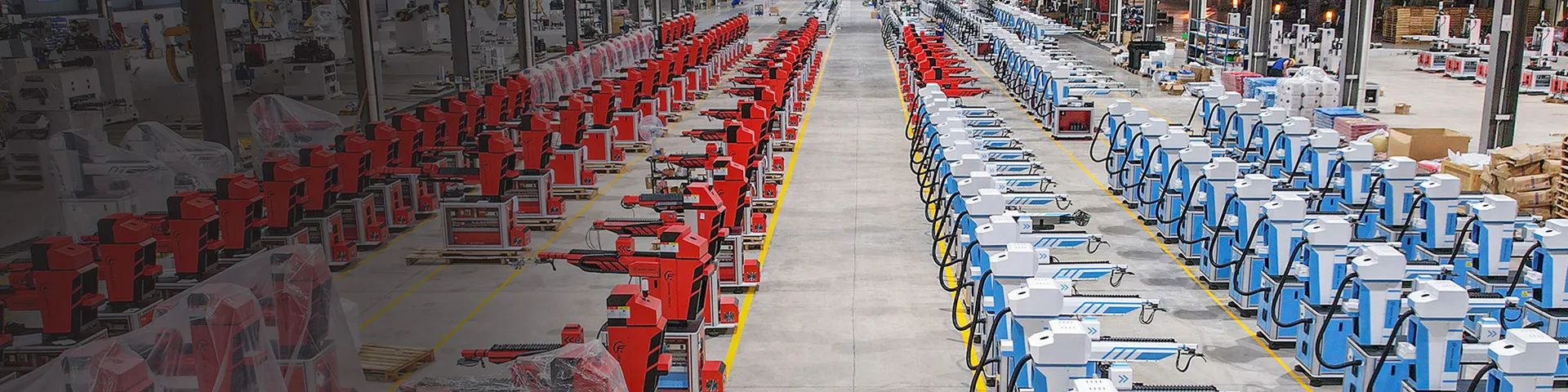
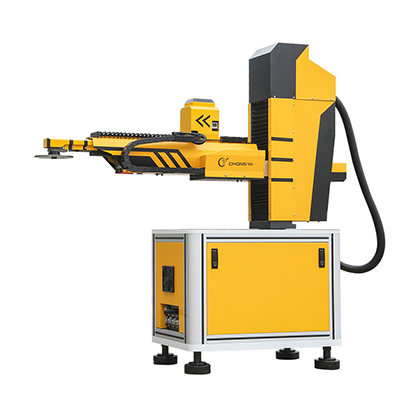
Certainly — below is a roughly 1000-word English article on **“Automatic Correction Technology of Stamping robot”**.
---
Automatic Correction Technology of Stamping robot
In modern manufacturing, Stamping robots play an increasingly important role in improving production efficiency, reducing labor costs, and ensuring product consistency. They are widely used in automotive parts, home appliances, hardware, and sheet metal processing industries. However, stamping operations often involve high speed, repeated motion, and strict precision requirements. Even a small positioning error can lead to defective parts, die damage, machine shutdown, or safety risks. For this reason, **automatic correction technology** has become a key function in Stamping robot systems.
Automatic correction technology refers to the ability of a robot to detect deviations from the expected position, posture, or trajectory during operation and automatically adjust itself to maintain accuracy. In stamping production, this technology helps robots compensate for errors caused by material variation, mechanical wear, vibration, thermal expansion, and sensor deviation. By applying automatic correction, the robot can continue stable operation with high precision and reliability.
1. Background and Importance
Stamping robots are commonly used to transfer workpieces between feeding, forming, and unloading stations. The robot must accurately grip the sheet metal or part, move it along a preset path, and place it into the next process position. In high-speed stamping lines, the cycle time is very short, and the tolerance is often only a few tenths of a millimeter. If the robot cannot detect and correct small deviations in time, the consequences may include collision with the press die, misalignment of the workpiece, or failure of the stamping process.
Traditional robots rely mainly on offline programming and fixed coordinates. This method works well under ideal and stable conditions, but real production environments are not always ideal. Materials may shift slightly during feeding, dies may wear over time, and the machine base may vibrate during repeated stamping. Therefore, automatic correction technology is necessary to improve adaptability and intelligence in Stamping robots.
2. Main Principles of Automatic Correction
The basic principle of automatic correction is “sense, compare, and compensate.” First, the robot or external sensors collect information about the actual position or state of the workpiece. Then, this data is compared with the standard reference values stored in the control system. If an error is found, the controller calculates a correction amount and adjusts the robot’s motion in real time or before the next cycle.
This correction can be divided into several types:
- **Position correction**: adjusts the robot’s location when the workpiece is slightly displaced.
- **Angle correction**: corrects the rotation angle of the workpiece or robot end-effector.
- **Trajectory correction**: modifies the movement path to avoid collision or improve accuracy.
- **Force correction**: changes motion based on contact force or resistance, especially in insertion or alignment tasks.
These functions are usually controlled by advanced servo systems, motion controllers, vision systems, and feedback sensors.
3. Common Technologies Used
3.1 Vision-Based Correction
Machine vision is one of the most important technologies in Stamping robot correction. Cameras installed near the feeding area or robot workstation capture images of the workpiece. The image processing software then identifies the position, shape, edge, and orientation of the part. Based on this information, the system determines whether the part is shifted or rotated and sends correction commands to the robot.
Vision-based correction has many advantages. It is non-contact, fast, and suitable for flexible production. It can handle different product types without changing mechanical fixtures too much. However, it also has challenges, such as sensitivity to lighting conditions, dust, oil stains, and reflective metal surfaces.
3.2 Sensor-Based Correction
Sensors are another major source of feedback. Common sensors include photoelectric sensors, laser displacement sensors, proximity sensors, and force sensors. Laser sensors are especially useful for detecting the position of metal sheets because they offer high precision and fast response. Force sensors can detect resistance when the robot clamps or inserts a part, allowing the system to adjust the motion based on actual contact conditions.
Sensor-based correction is highly reliable in industrial environments. It is often used together with vision systems to improve accuracy and robustness.
3.3 Servo and Encoder Feedback
Modern Stamping robots use servo motors with encoders that provide precise position feedback. Encoders can detect small motion errors during robot movement. If the actual position differs from the command position, the controller can make immediate adjustments. This closed-loop control improves repeatability and reduces accumulated error.
In high-speed stamping applications, servo feedback is essential because the robot must operate continuously and accurately over long production periods.
3.4 Adaptive Control Algorithms
With the development of industrial intelligence, many Stamping robots now use adaptive control algorithms, artificial intelligence, and machine learning. These systems analyze historical data, learn patterns of deviation, and optimize correction strategies automatically. For example, if a robot frequently detects a certain offset in one station, the system can predict this offset and apply compensation in advance.
Adaptive algorithms improve efficiency and reduce the need for manual reprogramming. They are especially useful in flexible manufacturing lines with frequent product changes.
4. Application Advantages
Automatic correction technology offers several significant benefits in stamping robot systems.
First, it improves **positioning accuracy**. The robot can detect small deviations and quickly correct them, ensuring that each workpiece is placed correctly in the die or transfer station.
Second, it increases **production stability**. Even when material dimensions vary slightly or the equipment experiences wear, the robot can maintain reliable operation.
Third, it reduces **scrap rate and downtime**. Accurate correction prevents stamping defects and avoids collisions that could damage the robot or die. This saves both material and maintenance costs.
Fourth, it enhances **flexibility**. Robots with automatic correction can adapt to different parts and process requirements more easily than traditional fixed-program robots.
Fifth, it improves **safety**. By detecting abnormal conditions early, the system can stop operation or adjust motion before dangerous errors occur.
5. Main Challenges
Although automatic correction technology has many advantages, it still faces several challenges in practical use. One problem is the complexity of the stamping environment. Metal surfaces often reflect light, oil mist and dust may interfere with sensors, and vibration may reduce measurement accuracy. Another problem is the need for high-speed processing. In stamping production, the correction decision must be made within a very short time, which requires powerful controllers and optimized software.
In addition, different products and production lines may require different correction methods. Integrating vision systems, servo control, and industrial communication networks also needs careful design and debugging. Therefore, successful implementation depends on both advanced technology and experienced engineering support.
6. Future Development
The future of automatic correction technology in stamping robots will likely move toward greater intelligence, integration, and autonomy. More advanced vision systems will provide better recognition in complex environments. Artificial intelligence will help robots learn correction rules from large amounts of data. Digital twin technology may also be used to simulate and optimize robot correction strategies before actual production.
At the same time, sensor fusion will become more common. By combining vision, force, laser, and encoder data, robots can make more accurate and reliable decisions. Edge computing and industrial internet technologies will allow real-time data analysis and remote monitoring, further improving system performance.
Conclusion
Automatic correction technology is a vital part of modern stamping robot systems. It enables robots to detect errors, adjust motion, and maintain high precision in difficult industrial environments. Through the integration of vision systems, sensors, servo feedback, and intelligent algorithms, stamping robots can achieve greater accuracy, stability, flexibility, and safety. As manufacturing continues to develop toward automation and intelligence, automatic correction technology will play an even more important role in improving the quality and efficiency of stamping production.
---
If you want, I can also:
1. **turn this into a formal academic essay**,
2. **simplify the English for students**, or
3. **add a title, abstract, and references**.
Ce site Web utilise des cookies pour vous garantir la meilleure expérience sur notre site Web.



 Téléphone
Commentaire
(0)